


ROADBOOK N°3 · BESPOKE
Photos M-Sirius and Cinquante mm, all rights reserved.
In 1977, the last Berlinette leaves the Dieppe factory. It is green, Vert Normand, with a yellow and black tartan interior, a configuration so particular that it has become iconic. Sold one day, then bought back years later by its first owner, it has come home. In 2026, Dieppe stops production of the new-generation A110. Between these two endings, a Ravage client had an idea: close the loop. Recreate the Berliverte, fifty years on, on one of the very last A110s built in 2026. Here is its story, and that of two cars that made the most of a beautiful autumn day to go for a drive together.
01 · 1977
Monsieur Limondin’s Berliverte
Jean-Pierre Limondin joins Alpine in 1963. A young engineer trained in Toulouse, he meets Jean Rédélé in Paris, starts as an apprentice, leaves to launch production in Mexico, then returns to Dieppe, to the avenue Pasteur workshops where bodies are still sanded outdoors. He is one of those who move the factory in May 1969 to avenue de Bréauté, where the Berlinettes of the great era will be born, then the A310. Sixty years later, he tells all of this with a mechanic’s precision and a father’s tenderness.
In 1977, he takes delivery of a 1600 SX. A 1,647 cc four-cylinder, 95 horsepower, 790 kg, 195 km/h. And a colour almost nobody chooses, when a third of customers order blue: metallic Vert Normand. It is the last Berlinette built in Dieppe, and its configuration, this rare green and this tartan, has become iconic. “Had I known it would be the last, I might have swapped my Vert Normand for an Alpine blue,” he smiles today. He never did. He did part with the car one day, then managed to buy it back years later: it has come home, and it will not leave again. Enthusiasts gave it a nickname: the Berliverte. In January 2026, it is shown at Rétromobile, alongside a works 1800 S Groupe 4 and the last A110 R.
 Photo Cinquante mm
 Photo Cinquante mm
 Photo Cinquante mm
Jean-Pierre Limondin, the 1600 SX badge, and the original tartan of the 1977 Berlinette, intact.

Video interview · YouTube
Jean-Pierre Limondin, a life at Alpine
Watch the interview
For those who want to know more about his extraordinary destiny at Alpine: a long interview, in French, to watch right here.
02 · 2026
Closing the loop
At the end of June 2026, the Dieppe Manufacture assembled its last new-generation A110. Nine years after Geneva, the car that brought the brand back to life also comes to a stop in Dieppe. Two A110 endings in the same town, forty-nine years apart. There was something there to celebrate.
A Ravage client, as passionate about history as about driving, suggested we do it together. Not a replica, not a pastiche: a tribute. Take one of the very last A110s built in Dieppe in 2026 and give it the soul of the first Berliverte, Monsieur Limondin’s, with his blessing. We said yes before he had even finished his sentence.
A project that brings together history and the future, with the rigour and precision of today, to build cars for enthusiasts. That is exactly why Ravage exists.
 Photo Cinquante mm
Studio Alpine Boulogne. The 1977 Berliverte and its 2026 tribute, side by side for the first time.
03 · The workshop
A tartan, an interior, carbon door sills: the haute couture of detail
It all started with the fabric. The famous yellow and black Scottish tartan of the 1977 seats, the one found in all the last Berlinettes, no longer existed. We had it made again for the occasion, pattern for pattern, in a modern cloth that meets the demands of a contemporary car: durability, colour fastness, touch. The design is that of 1977. The hand is ours.
Around it, an entirely new interior, designed for the Berliverte and for it alone: a very supple black nappa leather, light stitching, tartan inserts in the centre of the bucket seats and door panels, “Berliverte” embroidery on the leather. Nothing shouts, everything answers. A coherent configuration, conceived like a bespoke suit.
The door sills are a Ravage creation, and a nod to our all-carbon cars. Ultra-light sills, one millimetre thick, in the same material as our bodywork. A metallic grey lacquer, in the exact shade of the wheels, dresses them, and through the letters “Berliverte Hommage” you can see the carbon in depth. Handmade.
The project was carried out with Studio Alpine Boulogne, in Paris Ouest, which hosted the car and its delivery. Every part was designed, built and assembled in France.
The designer’s eye
Benoît Tallec, president of Ravage and former design director at McLaren, is used to leading bespoke car projects. A designer by profession, he is there to guide the client, steer and advise, and to imagine with his team extraordinary cars that answer their wishes. He distils dreams and desires into exceptional vehicles. The Berliverte was born that way: from a conversation, a memory, and a pencil.
 Photo M-Sirius
 Photo M-Sirius
 Photo M-Sirius
 Photo Cinquante mm
The yellow and black Scottish tartan made again for the occasion, the Berliverte embroidery and the one-millimetre carbon door sills, lacquered metallic grey, the carbon visible through the letters “Berliverte Hommage”.
 Photo M-Sirius
 Photo M-Sirius
 Photo M-Sirius
Like most of our cars, it was entrusted to our colleagues at M-Sirius for full PPF protection.
04 · The delivery
A black veil, two green cars, three generations
When the day comes, the 2026 Berliverte waits under a black veil at Studio Alpine Boulogne. Next to it, Jean-Pierre Limondin has brought his own. There is the client, his daughter, and a man who gave his life to Alpine, looking at the car he helped bring into the world in 1977 and the one paying tribute to it in 2026. The veil falls. Nobody speaks for a few seconds.
Then the phones come out, the doors open, the little girl settles behind the wheel, Monsieur Limondin photographs the two cars like a young man. It is for those seconds that we do this job.
And because a Ravage delivery is never just a handover of keys, it was also the occasion to share a good meal all together, and to put the world to rights. Yesterday’s world, tomorrow’s, and above all the world of the cars we love.
 Photo Cinquante mm
 Photo Cinquante mm
 Photo Cinquante mm
 Photo Cinquante mm
 Photo Cinquante mm
 Photo Cinquante mm
The veil, the unveiling, the family. Then the next generation at the wheel, Monsieur Limondin behind his phone, and the gift from Studio Alpine.
05 · The road
Two Berlivertes on a little road across the plain
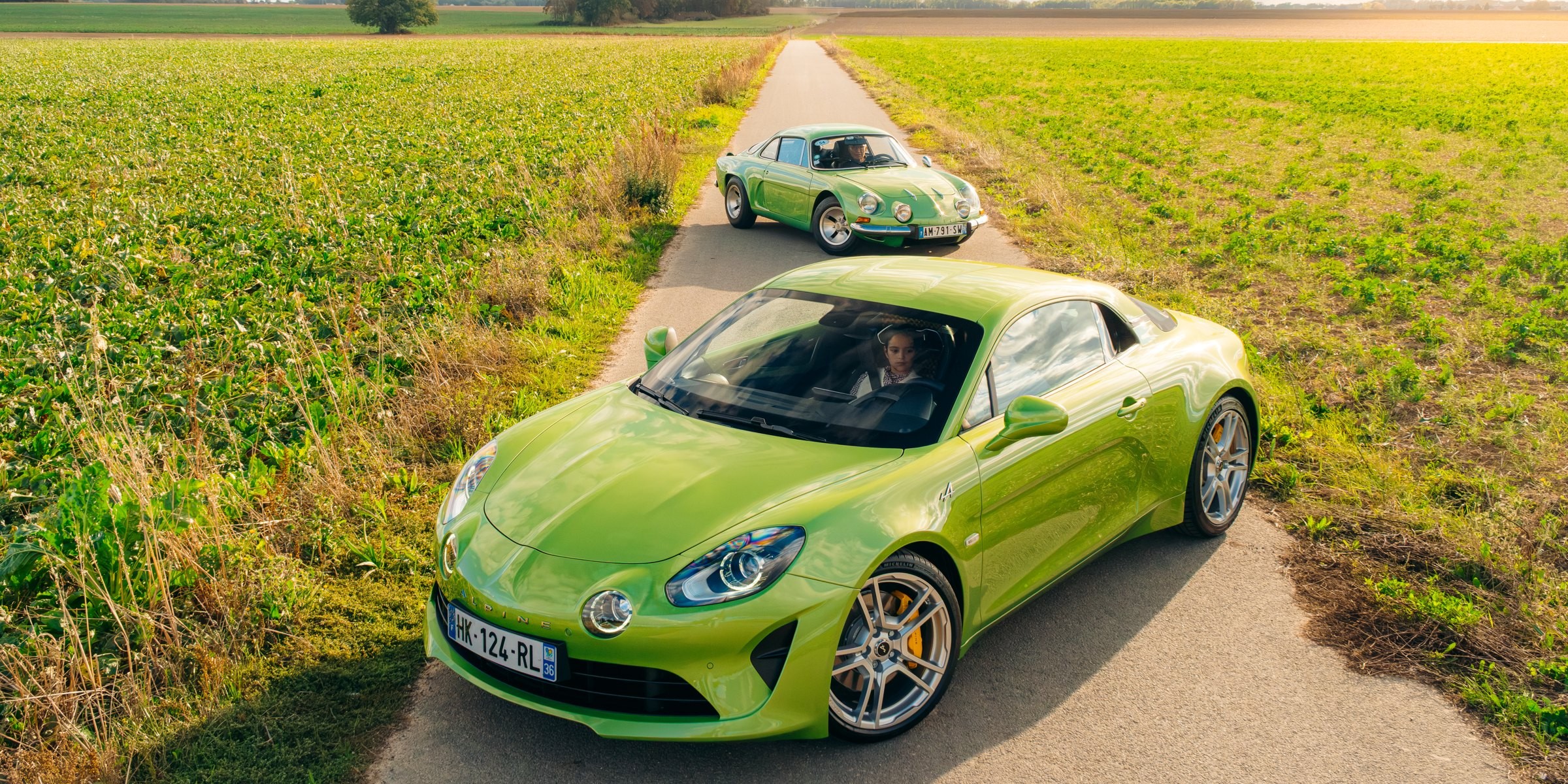
You do not deliver a car like this in a showroom alone. So the two Berlivertes took to the road, one behind the other, on a little straight road between the fields. 790 kg in front, a little over 1,000 behind. Forty-nine years apart, the same colour in the autumn light, the same tartan on the seats, the same smile at the wheel.
That, for us, is French savoir-faire: not a museum, but a transmission. From the hands that built the first Berlinette to the hands that stitched the latest interior, through a client who knew, at the right moment, how to connect the two. Every Ravage is unique. This one doubly so.
Then Monsieur Limondin gave one last wave, and drove straight off towards Dieppe. Home, at the wheel of his Berliverte, just like forty-nine years ago. And that was that.
 Photo Cinquante mm
 Photo Cinquante mm
 Photo Cinquante mm
 Photo Cinquante mm
 Photo Cinquante mm
 Photo Cinquante mm
Two Berlivertes, three generations, a little road across the plain.
 Photo Cinquante mm
Bespoke
Your story deserves its car.
A fabric, a colour, a family memory: we turn it into an interior, a configuration, a Ravage. Let’s talk about it.
Discover the Ravage interior